01 · The challenge
The Tactile Awareness Gap in Human-Robot Collaboration
In environments where humans and robots work side by side, precision and safety are non-negotiable. Yet fundamental limitations in tactile awareness continue to constrain robotic systems:
- Most robots still can’t sense where physical contact occurs on their surface
- Without this awareness, they can’t distinguish intentional interaction from unintended collisions – limiting how safely and intuitively they can operate in shared spaces
02 · The Solution
Self-Calibrating Artificial Skin for Intuitive Human-Robot Contact
- The artificial-skin system enables precise localization of physical contact using internal torque signals and surface geometry.
- Built-in calibration routine maps force data to specific surface areas, allowing rapid adaptation across various robot configurations.
- Lightweight control layer modulates behavior in response to contact, enabling compliant and intuitive interaction.
Impact
Replaced a $10K-per-arm sensor hardware setup with a software-only solution – cutting costs without compromising safety.
03 · Industrial Directions
Safe Human-Robot Collaboration in Assembly Line Manufacturing
Installation of robots in assembly lines where human–robot interaction is possible, such as conveyor-based manufacturing, where physical interaction and operational reliability are essential.
- A three-way collaboration between industry, Research organization, and the manufacturer
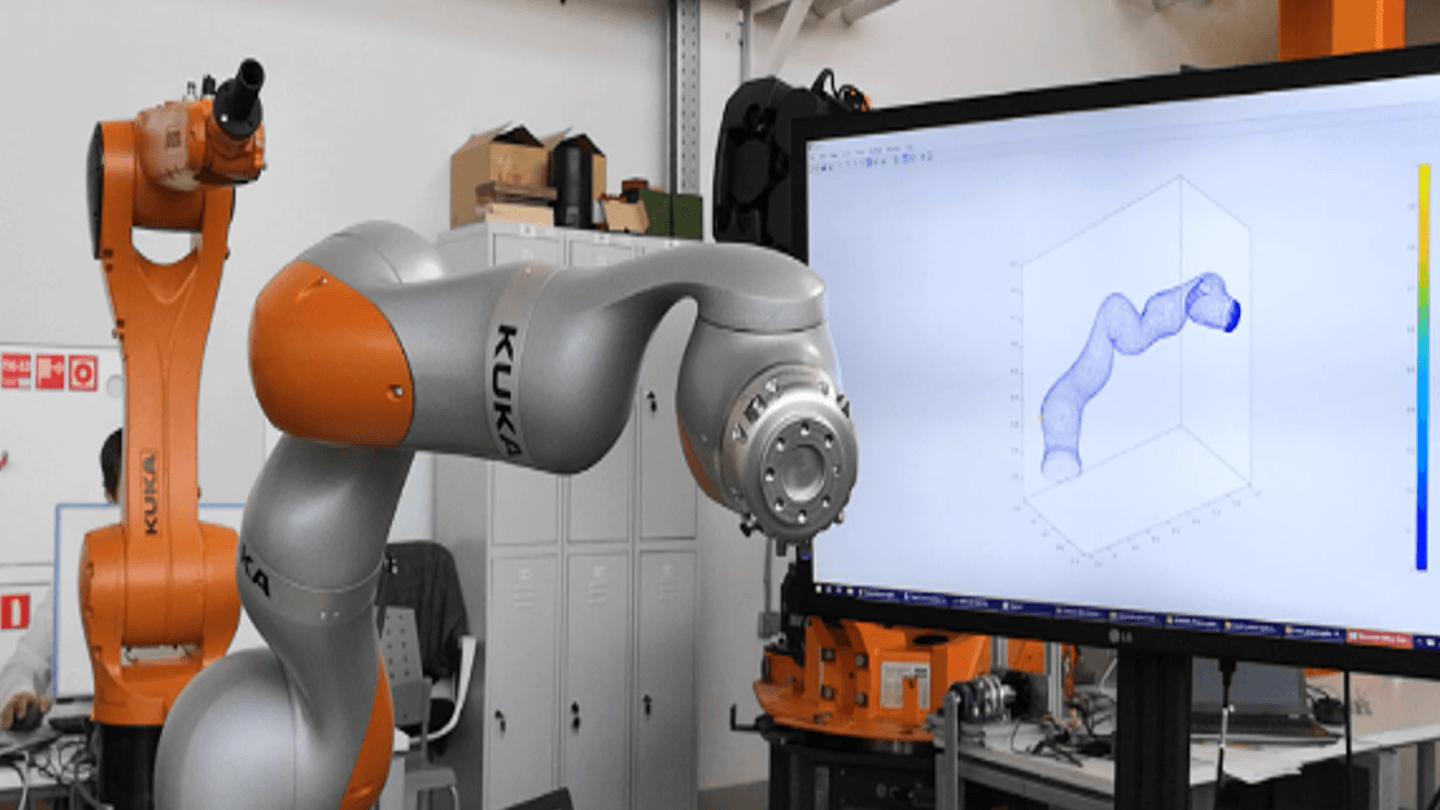
- Based on the hardware of KUKA (one of the world’s leading manufacturers of robotic manipulators)
- Assembly Operations, Automotive, Electronics, Human–Robot Interaction, Industrial Automation, Manufacturing & Engineering, Precision Engineering, Robotics, Robotics & Human Systems